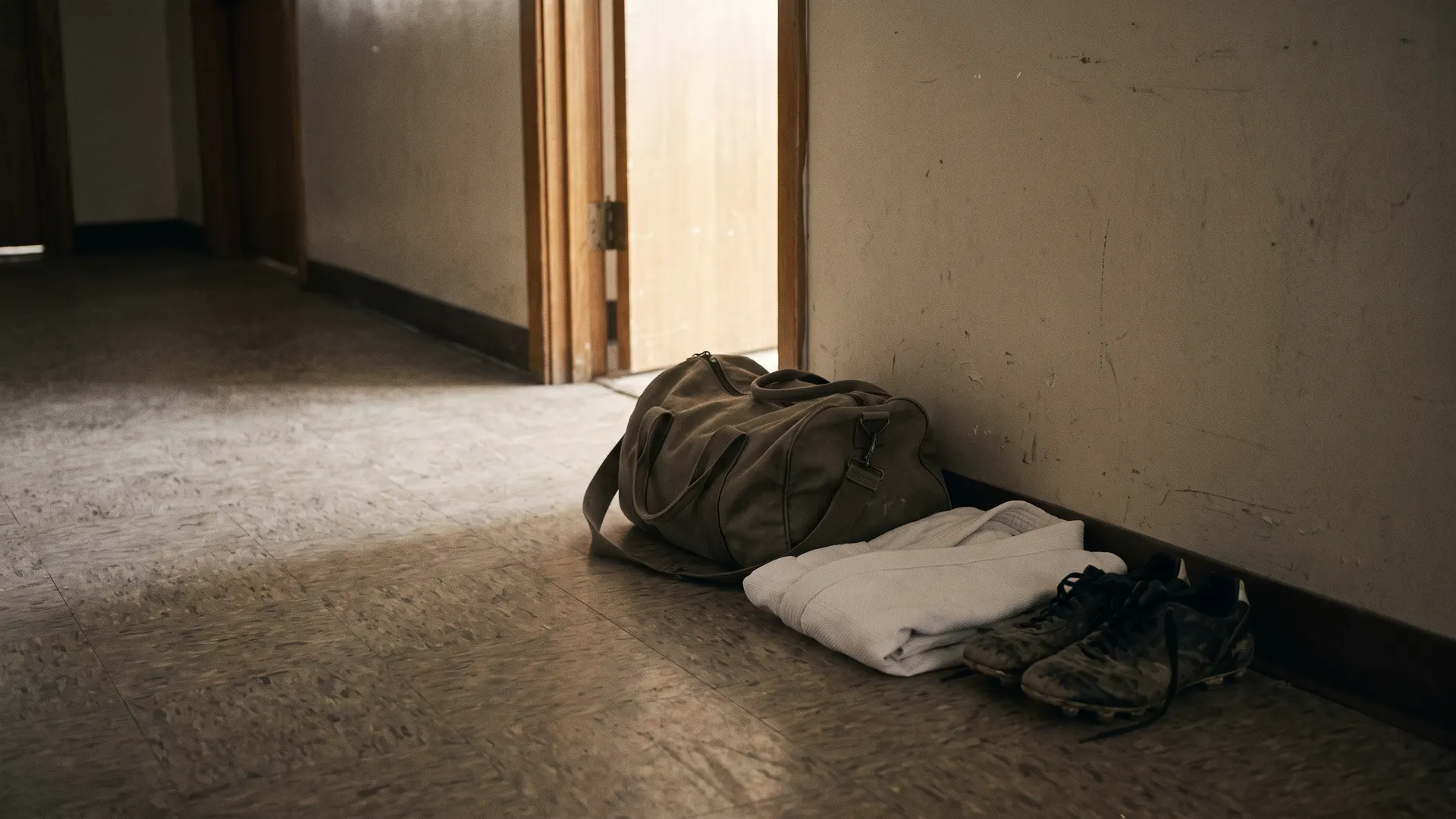
The gear bag has been sitting by the back door for nine days. Practice starts at five, and at 4:40 the bedroom door is still shut. When you ask, you get a shrug and a flat "I'm just over it." Two seasons ago this was the kid who talked you into a Sunday morning drive across town for open mat.
Most of us file that under changing interests, and sometimes that is exactly what it is. Kids try things and put them down. A fourteen-year-old is allowed to be done with the trumpet. But there is a version of quitting that has nothing to do with moving on, and the difference between the two is learnable. Catching it in September is a very different year than finding out in April.
This is the deep dive on that signal — what walking away from a sport, an instrument, or a friend group can be telling you, and how to answer it without turning your kitchen into an interrogation room.
Why Is Quitting Different From Simply Losing Interest?
Healthy quitting is a trade. The kid who is genuinely done with soccer has usually already found the thing replacing it — theater, a job, a different sport, a friend group that meets somewhere else. They can tell you a specific reason and it stays the same reason next week. They talk about it easily, without embarrassment. They keep the friendships they made there. Something got added.
The other version is subtraction with nothing on the other side of the ledger. The reason is vague, or it changes every time you ask. Their whole identity around the activity goes quiet — the posters come down, the group chat gets muted, the teammates they saw daily stop existing. And it rarely travels alone. Look for what else moved in the same stretch: sleep way up or way down, appetite changes, grades sliding, screen time replacing everything.
That pattern matters because losing interest in what you used to love is not a side effect of depression — it is one of its defining symptoms. The National Institute of Mental Health lists loss of interest in previously enjoyed activities among the core signs of teen depression, and describes symptoms that persist for at least two weeks and show up across settings. This is common ground, not a rare situation: NIMH statistics put 5 million adolescents aged 12 to 17 in the United States — 20.1% of that age group — as having had at least one major depressive episode in a recent year.
What Can Walking Away Actually Be Telling You?
Quitting is a symptom, not a diagnosis, and it points in several different directions. Knowing the options keeps you curious instead of certain.
Depression. The activity did not get worse; the capacity to enjoy it went flat. Everything costs more energy than it returns, so the most demanding thing on the schedule gets cut first. In the CDC's 2023 Youth Risk Behavior Survey, 39.7% of high school students reported persistent feelings of sadness or hopelessness — nearly four in ten. NIMH also reports that 14.7% of adolescents had a major depressive episode with severe impairment — depression heavy enough to disrupt school, home, or activities.
Anxiety. Avoidance works, which is the problem. Skipping practice brings instant relief, that relief teaches the brain that skipping is the answer, and the next practice feels harder than the last one. This is why anxiety-driven quitting often accelerates.
Burnout. Year-round, single-sport, no real off season, with adults treating a twelve-year-old's schedule like a career. Burnout usually announces itself as exhaustion and dread rather than sadness.
Bullying or a bad dynamic. Sometimes the sport is fine and one locker room, one teammate, or one adult is not. Kids will drop the whole activity before naming a person, especially if they think naming them creates a scene.
Shame about performance. They lost the starting spot, got moved up and got humbled, or found the exact edge of their talent in public. Quitting can be the cheapest way to stop being measured.
How Do You Respond Without Interrogating or Guilt-Tripping?
Take the sport off the table. While the conversation is about whether they are going back, they will defend a position instead of answering you. Lead with: "You don't have to go back. I do want to understand what changed." That sentence buys honesty because it costs them nothing.
Then open three doors at once: "Is it the sport itself, the people there, or how you feel about yourself when you're there?" Follow with "Was there a particular day it stopped being fun?" There usually was.
Retire the lines that close the door: "After everything we've paid for." "You're not a quitter." "You'll regret this." Each one tells a struggling kid that your disappointment is the real problem in the room.
Coaches, your move is a text, not an announcement: "Noticed you haven't been in. No pressure, and you don't owe me an explanation — your spot is here whenever you want it."
Then watch the clock. A change lasting more than two weeks that shows up in more than one part of their life is worth a call to their doctor or school counselor. Mental Health America reports that more than half of youth with major depression receive no mental health treatment at all — adults noticing early is much of how that changes. Keep our crisis and support resources somewhere your kid can find them. If a young person tells you they are thinking about suicide, take it seriously, stay with them, and call or text 988 together.
How You Can Help
Keeping the door open is most of the job. That means the spot stays theirs, the coach still says hello at the grocery store, and nobody makes a speech when they walk back in six weeks later. Kids return to rooms where returning is not a scene.
Tap Out Depression works to keep that room available for young people who could not otherwise walk into it. Our youth sponsorship program covers training costs for at-risk kids, so that money is never the reason a young person loses their community. You can support the mission here, or start with our healing resources if you are working through this with your own family.
A kid who quits has not told you they are finished. They have told you something changed. Ask what.
By Tap Out Depression
Last reviewed September 2026
Tap Out Depression is a 501(c)(3) nonprofit using the discipline of Brazilian Jiu-Jitsu to raise mental health awareness and serve communities in need. Learn more about our mission.
Resumen en Español
Cuando un adolescente abandona de repente el deporte, la música o el grupo de amigos que amaba, no siempre se trata de un simple cambio de intereses. Dejar algo de forma sana casi siempre viene acompañado de algo nuevo; en cambio, cuando la razón es vaga y además cambian el sueño, el apetito, las calificaciones y las amistades, puede ser una señal de depresión, ansiedad, agotamiento, acoso o vergüenza por su rendimiento. Pregunte sin interrogar — "no tienes que volver, pero quiero entender qué cambió" — y evite el chantaje emocional. Si el cambio dura más de dos semanas y aparece tanto en casa como en la escuela, hable con su médico o con el consejero escolar.
Recursos de crisis en español: EE. UU.: llame o envíe un mensaje de texto al 988 (oprima 2 para español). Envíe AYUDA al 741741 (Crisis Text Line en español). Global: findahelpline.com.
Crisis Support Resources
- USA: Call or text 988 (Suicide & Crisis Lifeline) | Text HOME to 741741 (Crisis Text Line)
- UK: 116 123 (Samaritans)
- Canada: Call or text 988
- Australia: 13 11 14 (Lifeline)
- International: findahelpline.com — crisis lines in 130+ countries
Disclaimer: Tap Out Depression is not a therapy or counseling service. The content on this site is for informational and educational purposes only and is not a substitute for professional mental health advice, diagnosis, or treatment. If you are experiencing a mental health crisis, please contact a licensed professional or call 988.