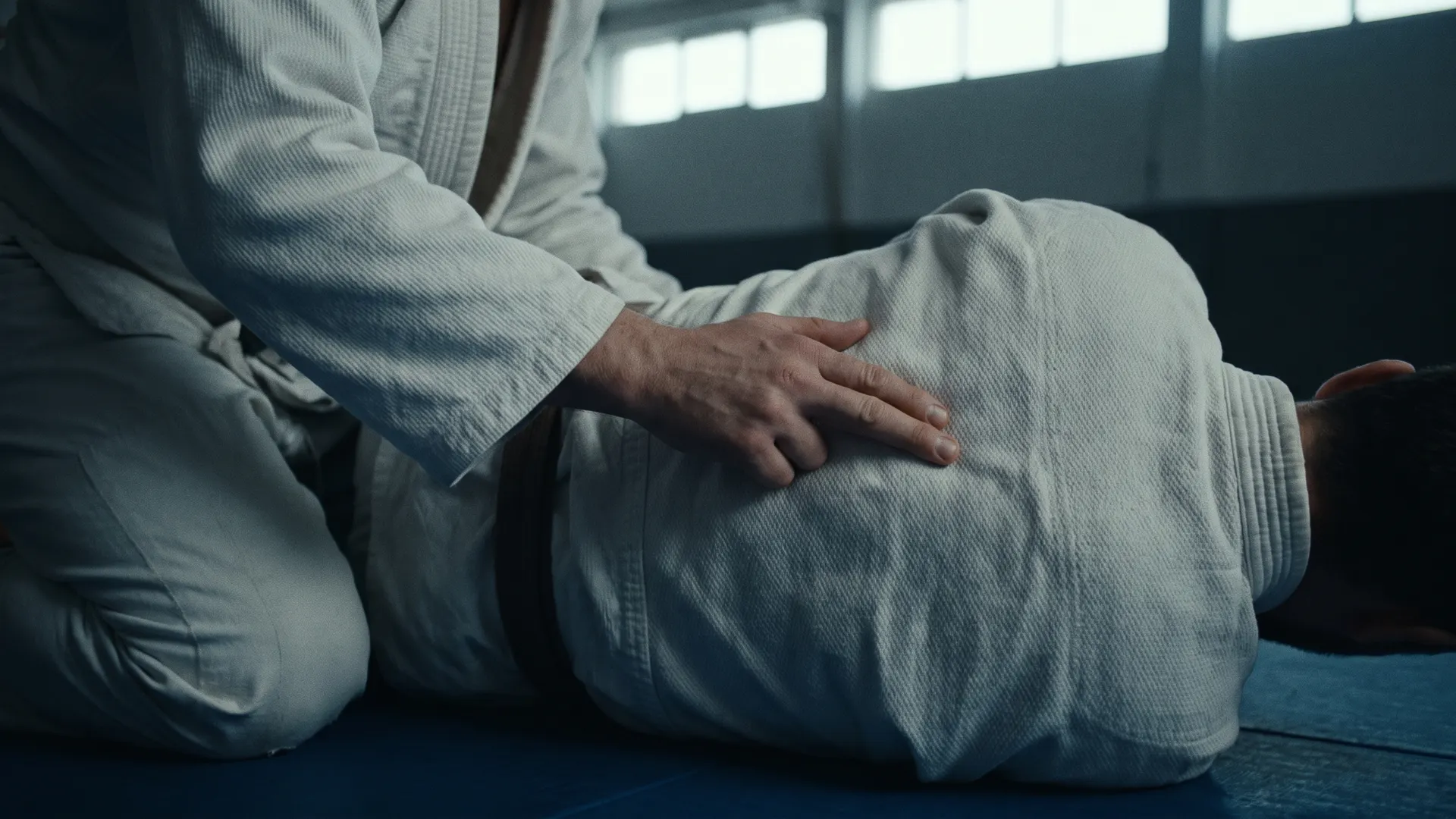
A purple belt taps four times in a forty-minute class. Once to a collar choke he saw coming. Once to a knee slice he did not. Twice to an armbar from a training partner who is forty pounds lighter and considerably better at this than he is. Nobody looks up. Nobody says a word about it. They slap hands and go again.
Then he drives home and does not tell a single person that he has not slept properly since March.
That gap is the reason this organization is called what it is. The tap is one of the cleanest pieces of communication in any sport: I am caught, this is past my limit, stop. It is not a negotiation. Your partner does not ask you to prove it, does not tell you to push through, does not bring it up in the parking lot afterward. Two taps on the shoulder and the pressure comes off. Every person in that room has done it hundreds of times, and not one of them thinks less of anybody for it.
Away from the mat, those same people will carry depression for years without saying anything to anyone.
Why Do People Who Tap Fifty Times a Week Refuse to Tap Off the Mat?
Start with how common the thing they are hiding actually is. The National Institute of Mental Health estimates that 21.0 million U.S. adults had at least one major depressive episode in 2021 — 8.3% of all adults. Of those adults, 61.0% received any treatment in the past year, which is another way of saying roughly two in five received none at all.
The gap is wider for men. NIMH puts the prevalence at 10.3% among women and 6.2% among men, and part of that difference is almost certainly who is willing to say something. Mental Health America reports that nearly 20% of American adult men — about 24.6 million — experienced a mental health condition in the past year, and that men are two times less likely than women to seek out help. In 2025, roughly 349,000 men took a free MHA screening, and three out of four scored at risk for a mental health condition.
On the mat, tapping costs you nothing, because everyone taps and everyone knows it. Off the mat, people quietly price the same signal at their whole identity — provider, coach, the person others lean on. So they wait. The position gets worse while they wait, which is exactly what happens when you refuse to tap to a tight armbar.
What Does the Mat Already Teach You About Signaling?
The tap is not a moment of surrender that happens to you. It is a trained skill with three parts, and you drill all three every single class.
First, you learn to recognize you are caught while there is still time — before the elbow, not after. Second, you learn to act on that recognition immediately instead of arguing with it. Third, and this is the part that changes people, you learn that the signal will be honored. Nobody in a healthy room holds a submission an extra beat to make a point. That reliability is what makes tapping cheap, and cheap signals get used.
The mat also reframes being caught. You were not defeated as a person; you were in a bad position and someone found it. Research published in the Journal of Functional Morphology and Kinesiology surveyed 420 Brazilian Jiu-Jitsu athletes across five belt ranks and found that higher-ranked athletes reported significantly greater self-control (p = 0.002), resilience (p = 0.028), grit (p < 0.001), and life satisfaction (p = 0.004), along with fewer reported mental health difficulties. That study is cross-sectional, so it cannot tell us whether the years of training built those qualities or whether the people who already had them are the ones who stuck around. Either way, the room is full of people who have practiced saying stop out loud, with their hands, in front of witnesses.
What Does Tapping Out Look Like Away From the Gym?
It is smaller than people expect, and it has levels.
- Tell one person. Not the whole team. One. "I have been in a bad way for a while and I have not told anybody" is a complete tap. You do not owe details, a diagnosis, or a plan.
- Tell a professional. A doctor, a therapist, an employee assistance line, a community clinic. This is the tap that gets real pressure off, and it is the one most people skip.
- Use the crisis lines. In the U.S., call or text 988 for the Suicide & Crisis Lifeline, or text HOME to 741741. They are free and confidential, and you do not have to be at your worst point to use them.
The room around a person matters. A qualitative study in Frontiers in Psychiatry followed 12 men living with depression and found that men-only peer groups were one of the things that made disclosure possible: you can show weakness there, and it will not be read as weakness. Small sample, but it describes something many gyms already have and rarely use on purpose.
Building that culture is simple. Coaches say it out loud, more than once: tapping is not quitting, and neither is calling somebody. Crisis numbers go on the wall by the class schedule. When a regular disappears for two weeks, somebody texts. Nobody is asked to explain themselves in front of the room. And the standing rule stays honest — training supports professional care and never replaces it.
How You Can Help
Tap Out Depression exists to keep this door open for people who need the community and cannot pay their way in, and to make sure the tap gets talked about off the mat as much as on it. You can support our mission, volunteer with us, or send our healing resources to somebody who needs them. And if a training partner has gone quiet, tap first — ask them this week.
By Tap Out Depression
Last reviewed September 2026
Tap Out Depression is a 501(c)(3) nonprofit using the discipline of Brazilian Jiu-Jitsu to raise mental health awareness and serve communities in need. Learn more about our mission.
Resumen en Español
En el jiu-jitsu, tocar (hacer "tap") no es rendirse: es una señal clara que se respeta al instante y que nadie juzga. Pedir ayuda con la salud mental funciona igual, aunque cueste mucho más. Empiece pequeño: dígaselo a una sola persona, hable con un profesional de la salud y use las líneas de crisis si lo necesita. El entrenamiento acompaña la atención profesional; nunca la reemplaza.
Recursos de crisis: EE. UU. 988 (oprima 2 para español) | envíe AYUDA al 741741 (Crisis Text Line en español) | Global: findahelpline.com
Crisis Support Resources
- USA: Call or text 988 (Suicide & Crisis Lifeline) | Text HOME to 741741 (Crisis Text Line)
- UK: 116 123 (Samaritans)
- Canada: Call or text 988
- Australia: 13 11 14 (Lifeline)
- International: findahelpline.com — crisis lines in 130+ countries
Disclaimer: Tap Out Depression is not a therapy or counseling service. The content on this site is for informational and educational purposes only and is not a substitute for professional mental health advice, diagnosis, or treatment. If you are experiencing a mental health crisis, please contact a licensed professional or call 988.
Sources
- National Institute of Mental Health — Major Depression statistics
- Mental Health America — Let's Talk About Men's Mental Health
- Journal of Functional Morphology and Kinesiology — Rank-Based Psychological Characteristics in Brazilian Jiu-Jitsu Athletes (PMC11932194)
- Frontiers in Psychiatry — Masculinity and Help-Seeking Among Men With Depression (PMC7732518)