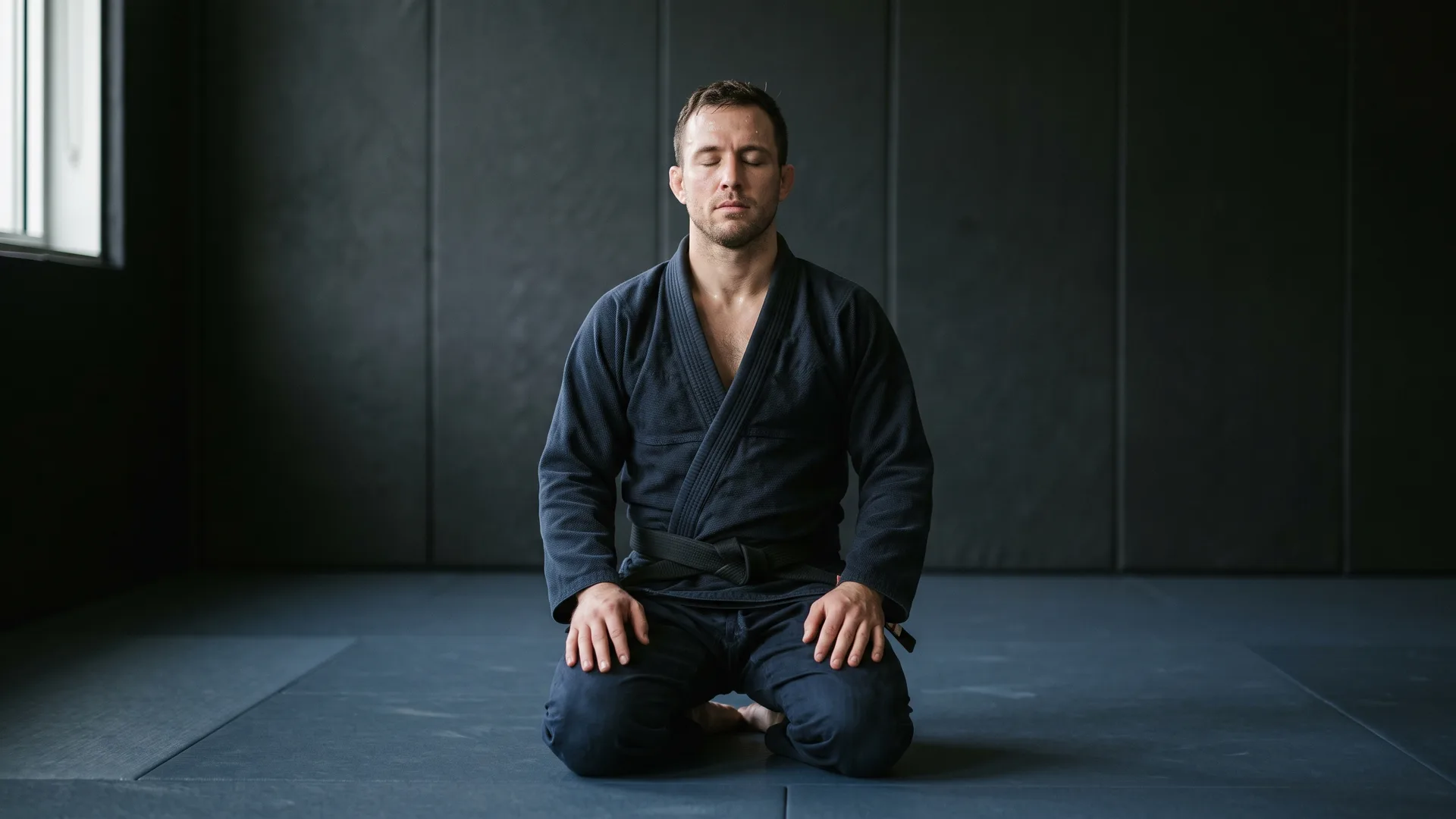
There is a moment in almost everyone's first month of jiu-jitsu when a training partner settles into side control and the world gets very small. Your chest is compressed. Your breath is short. Your heart is going. And the only instruction that matters is the one the coach keeps repeating from the edge of the mat: breathe, and find the one thing you can still move.
If you live with anxiety, that probably sounds like a nightmare rather than a help. Racing heart, tight chest, nowhere to go — that is the shape of a panic attack. But that overlap is exactly why the mat is useful for a lot of anxious people, and it is also exactly why it backfires for some. Both are true. Anyone who tells you only the first half is selling you something.
We want to be clear before going further: jiu-jitsu is not a treatment for an anxiety disorder, and we are not a clinic. What a good room can be is a place to practice being uncomfortable on purpose, with people paying attention to you while you do it.
Why Does Controlled Pressure Help an Anxious Nervous System?
Anxiety teaches you to read your own body as an alarm. A fast heartbeat stops being a fast heartbeat and becomes evidence that something is about to go wrong. The sensation and the catastrophic story get welded together, and eventually the sensation alone is enough to start the spiral.
Exercise pulls those two apart. The American Psychological Association notes that exercise can be particularly helpful for people who deal with anxiety and panic attacks, because it produces many of the same physical responses — pounding heart, hard breathing, sweating — in a context where nothing is actually wrong. The body gets practice. The APA also points out that people show lower levels of stress hormones like cortisol and epinephrine after physical activity, and that the federal guideline of 150 minutes of moderate activity per week, or 75 minutes of vigorous activity, is enough to matter.
Jiu-jitsu is that principle with the volume turned up: sustained effort, elevated heart rate, and discomfort you signed up for and can end at any time. The long-term picture looks encouraging too. Writing for Psychology Today's Black Belt Brain, neuroscientist E. Paul Zehr describes a study of nearly 800 adult martial artists — average age about 45, with an average of almost three decades of training — whose anxiety and depression levels came in lower than the surrounding population. That is an association, not proof that training caused it.
What Does Breathing Under Pressure Actually Teach You?
Panic has a breathing pattern: fast, shallow, high in the chest. So does a beginner getting flattened out under someone's cross-face. The difference on the mat is that this pattern has an immediate physical consequence — you gas out, you get smashed, you lose the position. The slow exhale stops being a wellness assignment you skip and becomes a skill you need in the next forty seconds.
The other thing you rehearse is the tap. It is a boundary you set with your own hand, honored instantly, with no argument and no explanation owed. A lot of people carrying anxiety have gotten very good at not saying stop. Practicing that several times a night, in a room where it is completely normal, is not a small thing.
Then there is presence. You cannot rehearse tomorrow's hard conversation while someone is hunting your arm. Rumination needs spare attention, and a live round does not leave any. Research in the Journal of Functional Morphology and Kinesiology surveyed 420 Brazilian Jiu-Jitsu athletes across five belt ranks and found higher-ranked athletes reported significantly higher self-control (p = 0.002), resilience (p = 0.028), grit (p < 0.001), and life satisfaction (p = 0.004), plus fewer reported mental health difficulties. That study is cross-sectional, so it cannot tell us whether training built those traits or whether the people who already had them are the ones who stayed. Probably some of both.
Can Grappling Make Anxiety Worse — And What Do You Do If It Does?
Yes, it can, and leaving this part out hurts people. Being pinned. Weight on your chest. Hands near your throat. Another person deciding where your body goes. For someone with a history of assault, abuse, medical trauma, or combat, those are not neutral sensations — they are the exact inputs a nervous system already learned to read as an emergency. Getting flooded on the mat is not weakness; it is a body doing its job with old information. Watch for dread on the drive in, checking out mid-round, or panic that lingers hours after class.
- Start smaller than you think. Harvard Health's advice for using exercise against low mood is to start with five minutes a day of something you can sustain. Drilling is training; live rounds can wait.
- Tell your partner first. "Pressure on my chest is hard for me" is a complete sentence, and a good partner adjusts on the spot.
- Tap early, and tap to pressure. The tap is a tool, not a verdict.
- Choose your positions. Start from top or standing, and sit out what puts you underneath.
- Talk to a licensed professional. If close contact reliably triggers trauma responses, that deserves care from someone trained to treat it. Training supports that work; it cannot replace it.
For some people the mat is the one hour a week the noise stops. For others it is the wrong room at the wrong time — information, not failure. If you are in crisis, call or text 988.
How You Can Help
Tap Out Depression works to keep the door open for people who need this community and cannot pay their way in. You can support our mission, volunteer with us, or pass our healing resources to someone who needs them — and if a training partner has gone quiet, ask them about it this week.
By Tap Out Depression
Last reviewed August 2026
Tap Out Depression is a 501(c)(3) nonprofit using the discipline of Brazilian Jiu-Jitsu to raise mental health awareness and serve communities in need. Learn more about our mission.
Resumen en Español
El jiu-jitsu puede ayudar con la ansiedad porque le enseña al cuerpo que un corazón acelerado y una respiración agitada no siempre significan peligro, y porque exige estar completamente presente. Pero para algunas personas, sobre todo quienes tienen antecedentes de trauma, el contacto cercano puede activar la ansiedad en lugar de calmarla: empiece despacio, avísele a su compañero, toque temprano y hable con un profesional. El entrenamiento acompaña la atención profesional; nunca la reemplaza.
Recursos de crisis: EE. UU. 988 (oprima 2 para español) | envíe AYUDA al 741741 (Crisis Text Line en español) | Global: findahelpline.com
Crisis Support Resources
- USA: Call or text 988 (Suicide & Crisis Lifeline) | Text HOME to 741741 (Crisis Text Line)
- UK: 116 123 (Samaritans)
- Canada: Call or text 988
- Australia: 13 11 14 (Lifeline)
- International: findahelpline.com — crisis lines in 130+ countries
Disclaimer: Tap Out Depression is not a therapy or counseling service. The content on this site is for informational and educational purposes only and is not a substitute for professional mental health advice, diagnosis, or treatment. If you are experiencing a mental health crisis, please contact a licensed professional or call 988.
Sources
- American Psychological Association — Exercise, fitness and stress
- Psychology Today (Black Belt Brain) — Can the Fighting Arts Promote Positive Personality Traits?
- Journal of Functional Morphology and Kinesiology — Rank-Based Psychological Characteristics in Brazilian Jiu-Jitsu Athletes (PMC11932194)
- Harvard Health Publishing — Exercise is an all-natural treatment to fight depression