By nine in the morning in Riverside County, the sidewalk is already too hot to sit on. By two in the afternoon the Inland Empire is deep in triple digits, and on the worst August days it pushes past 110. If you have a home, that is an inconvenience — you pull the blinds, run the air, wait it out. If you are living outside, it is something else. It is a night that never cools enough to sleep, then another one, then a third. It is a body that never gets to reset. It is a mind trying to hold itself together on no rest, in conditions that would flatten any of us.
Heat gets talked about as a physical danger, and it is one. The Centers for Disease Control and Prevention (CDC) reports that more than 700 people in the United States die from heat-related causes every year, and that heat kills more Americans than any other weather hazard. But a long stretch of heat is also a mental health emergency — and out here, it arrives every summer, on schedule, for our unhoused neighbors.
What does relentless heat do to the mind, not just the body?
Start with sleep. When overnight lows stay in the eighties, there is no recovery window. Sleep loss stacks up night after night, and anyone who has worked a week of bad nights knows what comes next: a short fuse, a foggy head, a body that feels heavier than it should. Add dehydration, sun exposure, and the constant work of finding shade, water, and a bathroom, and the day is spent before it starts.
That matters for mental health, and public health agencies say so directly. The CDC lists people living with mental health conditions among the groups at higher risk during extreme heat events, and researchers studying hot-weather periods have documented rising emergency visits for mental-health-related concerns as temperatures climb. Heat does not create depression. What it does is strip away the things that hold a person steady — sleep, routine, appetite, energy, the ability to think a problem through — and it does that to people who often have the least cushion to lose.
Now layer in who is out there. The National Alliance to End Homelessness reports that roughly one in five people counted as experiencing homelessness in the U.S. lives with a serious mental illness, and that people without stable housing carry far higher rates of chronic health conditions than the general population. A heat wave lands hardest on the people already carrying the most.
Why does heat make isolation and despair worse?
Heat shrinks the map of where a person is allowed to exist. Shade in the Inland Empire is mostly private property — a storefront awning, a restaurant patio, a parking structure. Sitting in it usually means being asked to move along, and being asked to move along fifteen times a day teaches a very specific lesson about your place in a community.
Cooling centers help, and they are worth knowing about, but reaching one is not simple. It may be three miles away with no bus fare. It may close at five, when the pavement is still radiating. And going often means leaving behind a tent, a bike, medication, or documents that took months to replace the last time they went missing. People make a rational trade: stay with everything you own, and cook.
So the heat pushes people further out — into riverbeds, washes, and back lots where there is a little shade and less contact with anyone. Fewer conversations. Fewer check-ins. Fewer chances for someone to notice that a person is not doing well. Unsheltered homelessness is exactly the situation the U.S. Interagency Council on Homelessness flags as the hardest to reach and the most dangerous to survive, and summer is when that isolation tightens. Despair does not usually announce itself. It grows quietly, in the places where nobody comes by.
What actually helps someone living outside in a heat wave?
Plain things, done consistently. Cold water first, and more of it than you think — a case goes fast on a 108-degree day. Electrolyte packets or sports drinks, because water alone does not replace what a full day of sweating takes out. Shade and sun protection: wide-brim hats, sunscreen, lightweight long-sleeve shirts, clean socks, cooling towels, lip balm. Food that survives a hot car — pop-top fruit, tuna packets, applesauce, crackers. Skip the chocolate and the granola bars that turn to soup.
Information belongs in the kit too. A printed card with the nearest cooling center hours, the 211 line for local shelter, transit, and heat-relief information, and 988 for mental health crisis support costs nothing and travels well. SAMHSA centers this kind of low-barrier outreach and referral in its homelessness and housing work: meet people where they are, connect them to services, keep showing up.
And then the part no kit contains. Ask a name. Say your own. Ask what they actually need instead of guessing — sometimes it is socks, sometimes it is a phone charge, sometimes it is two minutes of conversation with someone who is not in a hurry. Do not film. Do not preach. If someone shows signs of heat illness — confusion, no sweating, a very hot body, fainting — call 911 and stay until help arrives. Being treated like a person is not the soft part of outreach. On a day like that, it is the part people remember.
How You Can Help
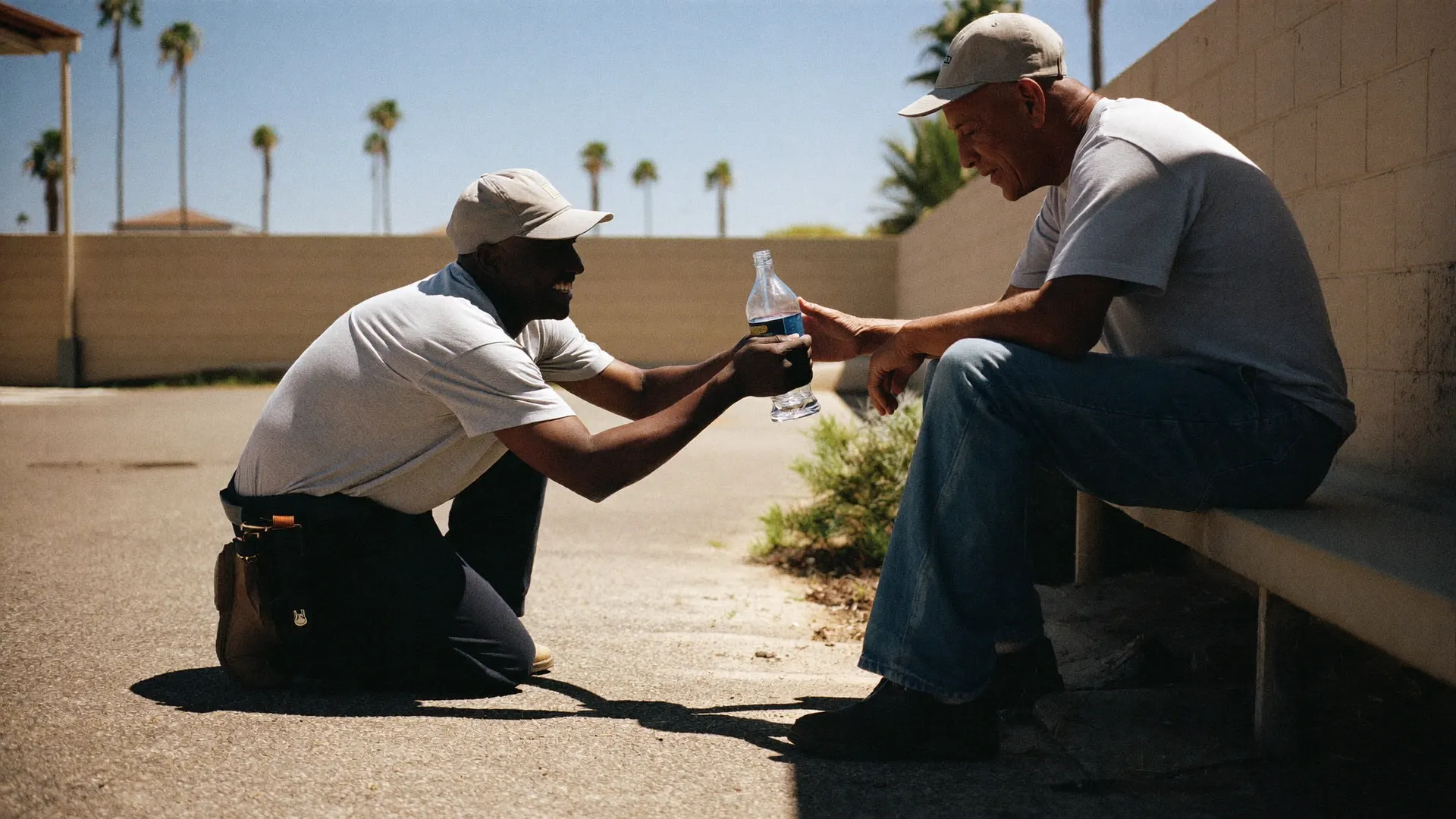
Keep a heat kit in your trunk this month: water, electrolyte packets, a hat, sunscreen, socks, and a resource card. When you hand one over, hand it over the way you would to a training partner — eye contact, no speech attached.
If you want to go further, join us on an outreach run in Riverside County, or support the summer care kits that stock our meal bags with cold water, electrolytes, and sun protection through the hottest weeks of the year. If you are the one struggling in this heat, our get help page lists resources, and you can call or text 988 any hour of any day. Nobody should have to get through an Inland Empire August alone.
By Tap Out Depression
Last reviewed August 2026
About the author: Tap Out Depression is a 501(c)(3) nonprofit using the discipline of Brazilian Jiu-Jitsu to raise mental health awareness and serve communities in need. Learn more about our mission.
Resumen en Español
El calor extremo del verano en el Inland Empire no solo es peligroso para el cuerpo: también afecta la salud mental de nuestros vecinos sin hogar. Noches sin dormir, deshidratación y falta de sombra aumentan el agotamiento, la irritabilidad y la desesperanza, y empujan a las personas a lugares aislados donde nadie las ve. Lo que más ayuda es sencillo: agua fría, electrolitos, sombra, protección solar, información sobre centros de enfriamiento (llame al 211) y un trato digno.
Recursos en español: EE. UU. 988 (oprima 2 para español); envíe AYUDA al 741741 (Crisis Text Line en español); internacional: findahelpline.com.
Crisis Support Resources
- USA: Call or text 988 (Suicide & Crisis Lifeline) | Text HOME to 741741 (Crisis Text Line)
- UK: 116 123 (Samaritans)
- Canada: Call or text 988
- Australia: 13 11 14 (Lifeline)
- International: findahelpline.com — crisis lines in 130+ countries
Disclaimer: Tap Out Depression is not a therapy or counseling service. The content on this site is for informational and educational purposes only and is not a substitute for professional mental health advice, diagnosis, or treatment. If you are experiencing a mental health crisis, please contact a licensed professional or call 988.