Ask a group of donors what belongs in a care kit and you get the same list every time: granola bars, a travel toothbrush, a hotel shampoo bottle, maybe a blanket. Ask someone who has been sleeping outside since spring and the first answer is almost always one word. Socks.
That gap matters. Care kits are one of the most direct ways a gym, a team, or a family in Riverside County can do something real for unhoused neighbors — but a kit built on guesses gets set down and left on a curb, while a kit built on what people actually ask for gets opened before you are back in your car. The difference is rarely money. It is listening first and shopping second.
What do people living outside actually ask for?
Socks lead every list. Feet stay damp, shoes rarely come off, and clean dry socks are the item outreach teams run out of first. Buy new, buy crew length, buy in bulk.
After that the pattern is consistent: water, electrolytes, sun protection, and hygiene supplies a person can use without a bathroom. Those requests make sense given who is out there. The National Alliance to End Homelessness reports that about 275,000 people experienced unsheltered homelessness at the last national count in January 2024 — that is 275,000 people with no sink, no outlet, and nowhere to set anything down. The same organization also reports that nearly half of people experiencing homelessness have a disability, which is a good reason to keep every kit light enough to carry one-handed.
A kit that holds up on the street looks something like this:
- Two pairs of new socks
- A bottle of water plus two electrolyte packets
- Sunscreen, lip balm, and a disposable poncho
- Unscented wipes, hand sanitizer, and a small pack of tissues
- Travel toothbrush, toothpaste, comb, and a disposable razor
- Pads and tampons — the most requested and least donated item in outreach
- Adhesive bandages and blister pads
- Pop-top fruit, tuna or chicken packets, applesauce, crackers, nut butter
- A resource card with 211 for local shelter, food, and transit information, 988 for mental health and crisis support, and Text HOME to 741741
- A gallon zip bag as the container, so the whole kit is waterproof and flat
What should you leave out of a care kit, and why?
Most donations that fail do so for one of three reasons. They are too heavy, they need equipment the person does not have, or they arrive with a judgment attached.
Skip cans without pop-tops, because there is no can opener. Skip chocolate and anything that turns to liquid in a car parked in September sun. Skip anything that needs a fridge, a microwave, or hot water. Skip glass. Skip full-size shampoo and lotion bottles, which are mostly weight. Skip used shoes in whatever size you had lying around, and skip clothing that has not been washed and sorted — a donation someone has to carry and then throw away is a chore, not a gift. Leave cash out of a sealed bag, too; it turns the kit into a target.
The harder thing to leave out is the message. Kits sometimes show up with a pamphlet about life choices stapled to the outside, and that staple is the whole problem. It reads as a price tag. It is also built on a false premise: the National Alliance to End Homelessness reports that more than 90 percent of people experiencing homelessness would move into housing if it were available to them. Nobody out there is short on advice. What they are short on is housing, and until that shows up, dry socks and a person who treats them normally.
How do you hand someone a kit without taking their dignity?
Approach from the front, at a normal distance, and speak first. Say your name. Ask theirs, and then use it. Ask what they need instead of announcing what you brought — sometimes it is socks, sometimes it is a phone charge, sometimes it is a five-minute conversation with someone who is not in a hurry. Hand the kit over; do not toss it or set it down like a delivery. If someone is asleep, let them sleep and come back another day.
Do not film. Do not post a face. Do not lecture, quiz someone about their sobriety, or ask what happened to them. And if someone says no thanks, that is a complete sentence — say have a good one and keep walking.
This is not decoration around the real work. It is the work. The scale is enormous: the U.S. Interagency Council on Homelessness reported more than 650,000 people experiencing homelessness on a single night in January 2023, a 12 percent increase over the year before. No trunk full of kits solves that. But SAMHSA builds its homelessness work around low-barrier outreach and engagement for exactly this reason: consistent, respectful contact is what eventually connects a person to housing, treatment, and care. Somebody has to be the first friendly face. Repeat contact is what makes a resource card get used instead of pocketed.
How You Can Help
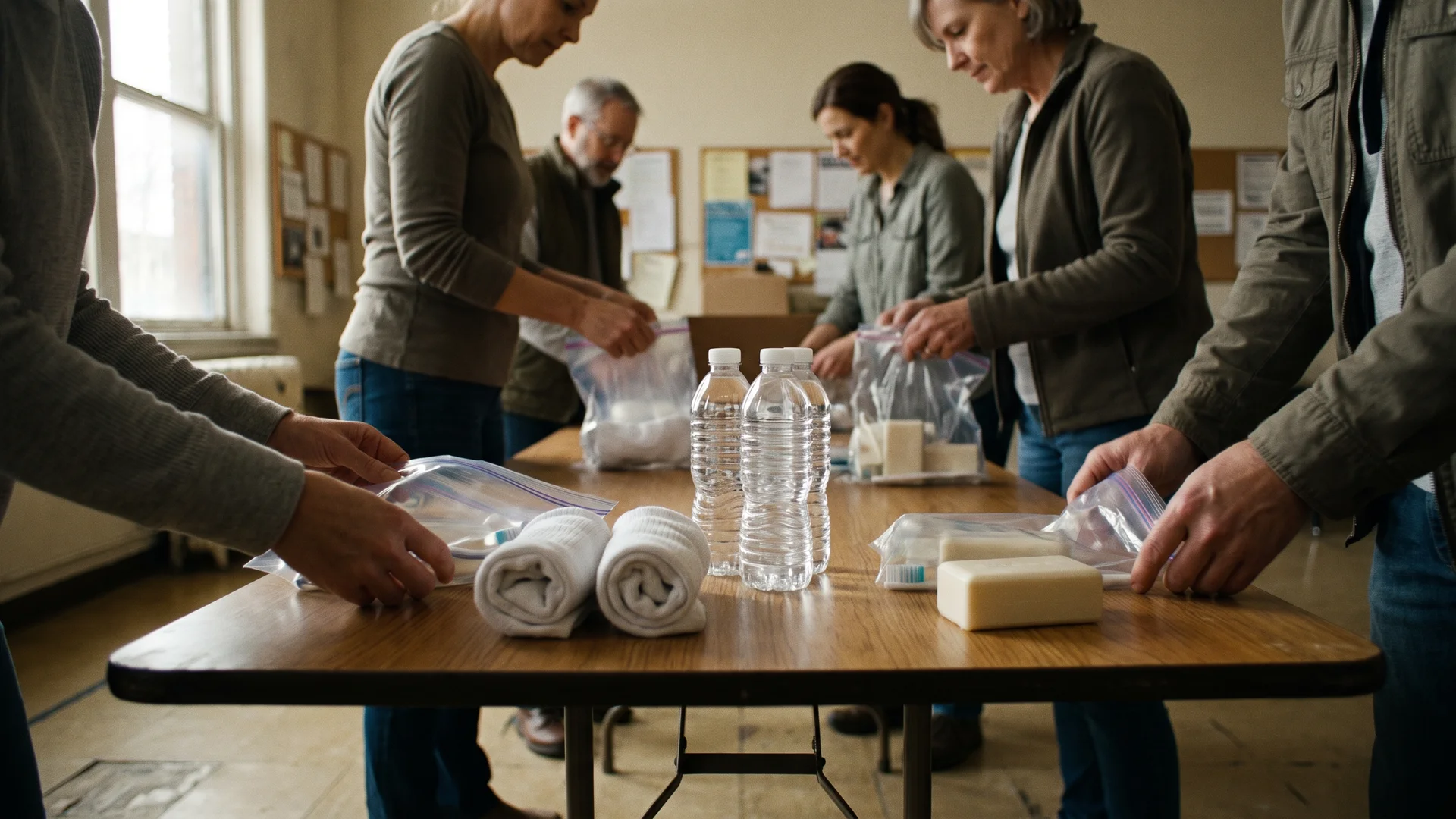
Pick a Saturday this month and build kits with your people. It works as an assembly line: buy socks, water, and hygiene supplies in bulk, put a folding table in the gym lobby or the driveway, print resource cards with 211 and 988, and let kids do the packing. Twenty-five kits takes about an hour. Keep three in your own trunk so you are never the person who drives past because you had nothing to offer.
If you want to take it further, come out on an outreach run with us in Riverside County, where you will learn more in one morning than any article can teach. You can also fund the care kits and meal bags we hand out across the Inland Empire year-round. And if you are the one reading this from a tent or a car, our get help page lists resources, and you can call or text 988 at any hour. You are not a project. You are a neighbor.
By Tap Out Depression
Last reviewed September 2026
About the author: Tap Out Depression is a 501(c)(3) nonprofit using the discipline of Brazilian Jiu-Jitsu to raise mental health awareness and serve communities in need. Learn more about our mission.
Resumen en Español
Los kits de ayuda funcionan mejor cuando se basan en lo que las personas sin hogar realmente piden, no en lo que suponemos. Lo más solicitado es sencillo: calcetines nuevos, agua, electrolitos, protector solar, toallitas, productos de higiene femenina y una tarjeta con recursos (211 para refugio y comida, 988 para apoyo en crisis). Evite el vidrio, las latas sin abrefácil, la ropa sin lavar y los folletos con consejos. Entregue el kit mirando a la persona a los ojos, pregunte su nombre y trátela como vecino, no como proyecto.
Recursos en español: EE. UU. 988 (oprima 2 para español); envíe AYUDA al 741741 (Crisis Text Line en español); internacional: findahelpline.com.
Crisis Support Resources
- USA: Call or text 988 (Suicide & Crisis Lifeline) | Text HOME to 741741 (Crisis Text Line)
- UK: 116 123 (Samaritans)
- Canada: Call or text 988
- Australia: 13 11 14 (Lifeline)
- International: findahelpline.com — crisis lines in 130+ countries
Disclaimer: Tap Out Depression is not a therapy or counseling service. The content on this site is for informational and educational purposes only and is not a substitute for professional mental health advice, diagnosis, or treatment. If you are experiencing a mental health crisis, please contact a licensed professional or call 988.
Sources
- National Alliance to End Homelessness — What Is Unsheltered Homelessness?
- National Alliance to End Homelessness — People with Unaddressed Health Conditions
- SAMHSA — Homelessness Programs and Resources
- U.S. Interagency Council on Homelessness (USICH) — HUD Releases January 2023 Point-in-Time Count Report